Key takeaways
- GPS on its own measures distance and average speed well. It misses short sprints, sharp accelerations and changes of direction, which a motion sensor fused with the GNSS data can capture.
- Update rate matters more than a datasheet accuracy figure. One position per second suits hiking or asset tracking; team-sport tracking usually needs around ten per second.
- The body blocks satellite signals, so antenna placement decides real-world accuracy. An upper-back vest position usually sees more sky than an armband or a wrist.
- Size the battery for a full session plus margin from measured current on representative hardware, and add live streaming only when someone will act on the data in real time.
The short answer: what decides a GPS tracker’s accuracy
GPS tracker development comes down to four engineering choices: which GNSS module you use and how often it reports a position, whether motion sensors back it up, where the antenna sits on the body, and how much battery the device carries for one session. Get those four right and the tracker reports distance, speed and sprint counts a coach can trust. Get one wrong and the numbers look plausible while being off by enough to mislead.
This guide covers those decisions for founders and product teams planning a sports or athlete tracker. It builds on the design decisions behind an IoT device, and it assumes you already know who will wear the device and what they want measured. Our page on fitness tracker development covers the wider market for founders still at the product-category stage.

Watch · 1:06 with Mohsin Aslam
GPS Tracker for Car: Design It for the Dashboard
Battery choice in a car tracker shows why runtime and heat belong in the first spec.
| Decision | What it controls | Typical trade-off |
|---|---|---|
| GNSS module and update rate | Position accuracy and how finely speed is sampled | Higher rate and multi-band cost power and unit price |
| Motion sensors (IMU) | Sprints, accelerations, changes of direction, impacts | More firmware work and more data to store |
| Antenna and wear position | How much sky the receiver sees during play | Best positions need a vest or a dedicated pocket |
| Battery capacity | Whether one session finishes before the device does | More capacity means more size and weight |
GNSS modules and update rate
GNSS (global navigation satellite system) is the umbrella term for GPS (United States), Galileo (European Union), GLONASS (Russia) and BeiDou (China). A modern receiver listens to several of these at once. More visible satellites means a steadier fix in places where stands, roofs or trees block part of the sky.
Two specifications matter more than the headline accuracy figure:
- Update rate. A 1 Hz receiver reports one position per second. A footballer at full sprint covers around 8 to 9 meters in that second, so a 1 Hz tracker sees the start and end of a short burst and very little in between. Team-sport tracking commonly runs at around 10 Hz.
- Single-band or multi-band. Multi-band receivers (for example L1 plus L5) reduce errors from signals bouncing off buildings and stadium structures. They cost more and usually draw more power.
| Update rate | Suits | What it misses |
|---|---|---|
| 1 Hz | Hiking, cycling, asset and pet tracking | Short sprints and fast direction changes |
| 5 Hz | Recreational running and general fitness | Peak acceleration in very short efforts |
| 10 Hz and above | Team sports and athlete monitoring | Little on its own; still needs motion data for impacts and jumps |
Treat the datasheet accuracy figure with care. It is measured in open sky with a reference antenna, which a tracker inside a sealed housing on a moving body never has. In our experience at Inventornest, one recurring cause of first-build issues is a component performing differently in the actual application from what its supplier claims. A GNSS module is a prime candidate, so plan to verify it on the body rather than on the bench.
Why you need motion sensors as well
This is the central choice in a sports tracker: position data alone, or position data fused with an inertial measurement unit (IMU). An IMU combines an accelerometer and a gyroscope, sometimes with a magnetometer, and samples motion far faster than any GNSS receiver reports position, commonly 100 times per second or more.
Sensor fusion in firmware gives you the strengths of each:
- The IMU samples acceleration directly, which means short sprints, decelerations and cuts are measured instead of estimated from two GPS points.
- The GNSS data anchors the IMU over time, which means the drift every motion sensor accumulates is corrected against a real position.
- The IMU keeps counting movement during brief GNSS dropouts, which means a player running under a stand does not vanish from the session.
The cost sits mostly in firmware. Sensor fusion, calibration and the algorithms that turn raw motion into “sprints” or “accelerations” are real engineering work, and they need field data to tune.

Position data alone cannot see a sprint
A GPS-only tracker is accurate over a session and blind inside a two-second burst. The metrics coaches ask for most are the ones that need motion sensing.
| Metric | GPS only | GNSS plus IMU |
|---|---|---|
| Total distance | Good over a full session | Good, with fewer gaps during dropouts |
| Top speed | Reasonable at 10 Hz, unreliable at 1 Hz | Better, because acceleration is measured directly |
| Sprint and acceleration counts | Short efforts are missed or blurred | Each burst is captured at 100 Hz or more |
| Changes of direction | Smoothed out between position fixes | Detected from the gyroscope |
| Impacts and jumps | Not measurable | Measurable, with tuned thresholds |
| Indoor sessions | No usable position | Motion load still recorded, without position |
| Engineering effort | Lower: module integration and logging | Higher: fusion, calibration and field tuning |
Antenna and placement on the body
The human body is mostly water, and water absorbs GNSS signals. A receiver pressed against the body sees roughly half the sky at best, and less when the wearer turns or bends. Where the tracker sits therefore decides real accuracy as much as the module does.
| Wear position | Sky view | Notes |
|---|---|---|
| Upper back, in a vest | Best | Common in team sports; stable and away from impacts to the limbs |
| Upper arm, in an armband | Partial | Convenient; the torso and head shadow it as the player turns |
| Wrist | Variable | Familiar form factor; the arm swings constantly, which adds noise to motion data |
| Boot or shin | Poor | Useful for stride detail; weak for position |
The antenna itself is a design decision too:
- Ceramic patch antennas offer better gain and need more room.
- Chip antennas save space, which means they depend heavily on the board’s ground plane and careful tuning.
- Clearance matters. The battery, metal fasteners and any metallic finish near the antenna all cost signal, which means the enclosure and board layout have to be designed around it.
Space is usually the constraint that forces the board design. At Inventornest, we have found that volume alone does not determine whether to use a module or a custom PCB: a low-volume wearable may need a custom PCB because space is limited.
Battery life per session
Start by defining the session. A 90-minute match is not 90 minutes of runtime once warm-up, half-time and the time the device sits switched on in the changing room are added. Write down the longest realistic day, such as a tournament with several games, and design for that plus margin.
The main power draws in a sports tracker, in rough order:
- The GNSS receiver at a high update rate, running continuously through the session.
- Any live radio link, if the device streams data during play.
- The IMU at a high sample rate.
- Writing data to flash memory.
- LEDs, a buzzer or a display.
At Inventornest, we select battery chemistry and capacity around power demand, required runtime, charging method, operating environment, size and replacement needs. We estimate energy consumption and check that estimate through measurements on representative hardware. Capacity should account for usable energy, conversion losses and an appropriate operating margin, rather than the advertised battery rating alone.
Runtime is roughly usable capacity divided by average current. As an illustration only, not a measured figure: a 400 mAh cell with 80 percent treated as usable after losses and margin gives 320 mAh; at an average draw of 80 mA, that is about four hours.
Battery optimization is often underestimated. A prototype may perform its main function successfully but still deliver inadequate battery life in everyday use, and addressing this can require another design iteration or, in substantial cases, redevelopment of the product. Treat runtime as a core requirement from the first specification, and measure it on the body across a full session. Battery chemistry, safety certification and shipping rules are a separate decision from runtime, and they need their own checks before launch.
Getting the data off the device
Every tracker has to move its data somewhere, and the first decision is timing: during the session or after it.
| Approach | How it works | Suits |
|---|---|---|
| Log, then sync | Data is stored on the device and transferred over Bluetooth Low Energy or a dock after the session | Training analysis, lower cost, longest battery life |
| Live streaming | Data is sent during play over cellular or a local radio to a sideline receiver | Coaches who change a session in real time based on load |
Live streaming adds a radio that runs throughout the session, a receiver or data plan, and more firmware and app work. At Inventornest, we advise against connectivity when it adds cost and complexity without solving a meaningful user problem. Ask who will act on live data, and how fast, before paying for it.
For the radio itself, we prefer an established, pre-certified wireless module when it meets the product’s requirements. It can reduce RF development effort and certification risk, although it does not automatically remove all testing obligations for the finished product. The trade-offs between radios are covered in our comparison of Wi-Fi vs Bluetooth for IoT products.
Testing in the field
A tracker that works on the bench has proven very little. The questions that matter (is the distance right, are the sprints counted, does the battery last) can only be answered on a moving body, outdoors, against a known reference.
In our experience at Inventornest, we usually need two PCB development iterations; depending on complexity and the issues found, a project may require four or five. Field testing is where most of the reasons for a second iteration appear, so plan the test protocol before the first boards arrive.
GPS tracker field-test protocol
Every check runs outdoors, on a person, against a reference you can measure independently. A bench result does not tick any box here.
Position accuracy
Speed and motion metrics
Power and runtime
Data and durability
Radio certification runs alongside this work. A tracker with Bluetooth or cellular needs FCC authorization in the United States, and a pre-certified module shortens that path.
Case study: a GPS sport tracker we built
The decisions in this guide are the ones we worked through on a GPS sport tracker for a coaching team. The project is under NDA, so this summary covers only what the client has allowed us to publish.
GPS sport tracker, concept to working prototype
A coaching team needed each player’s position and movement during training sessions, live and afterwards.
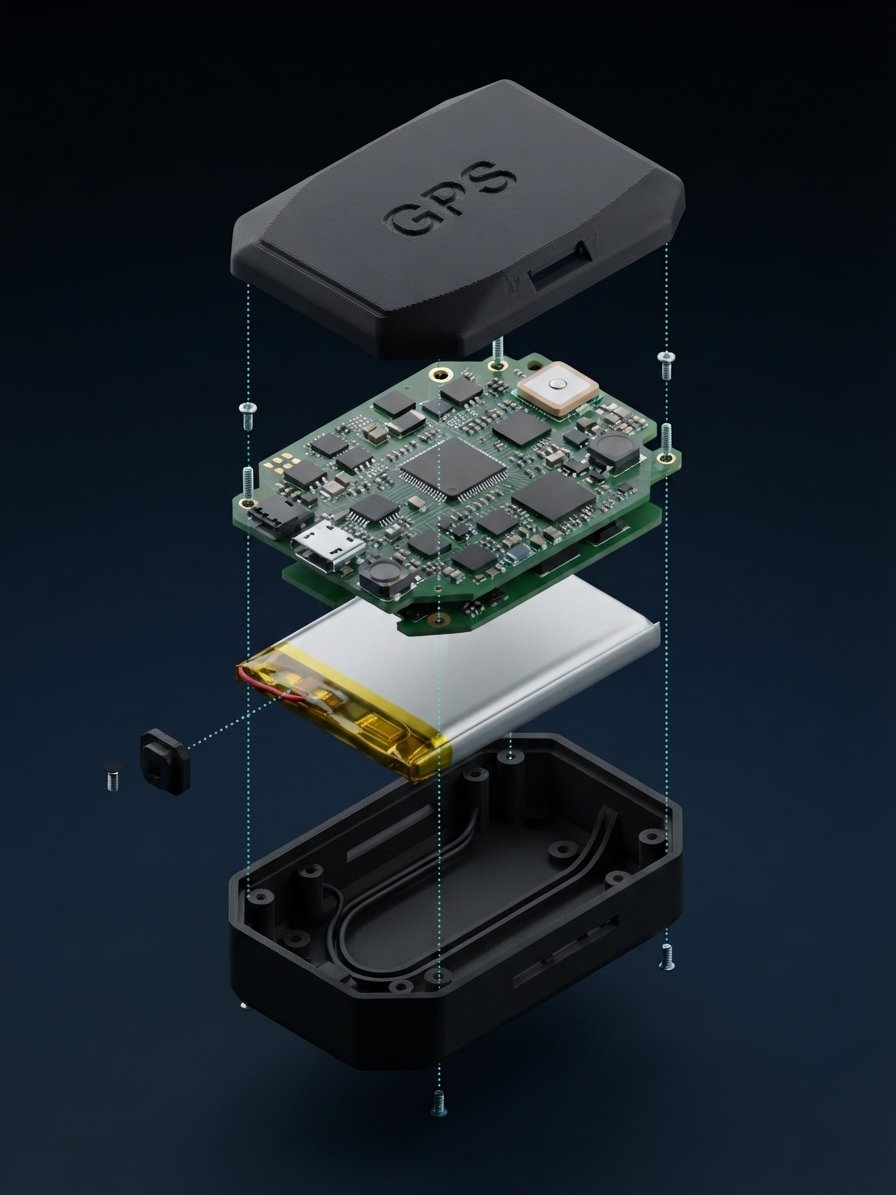 Housing, board, battery
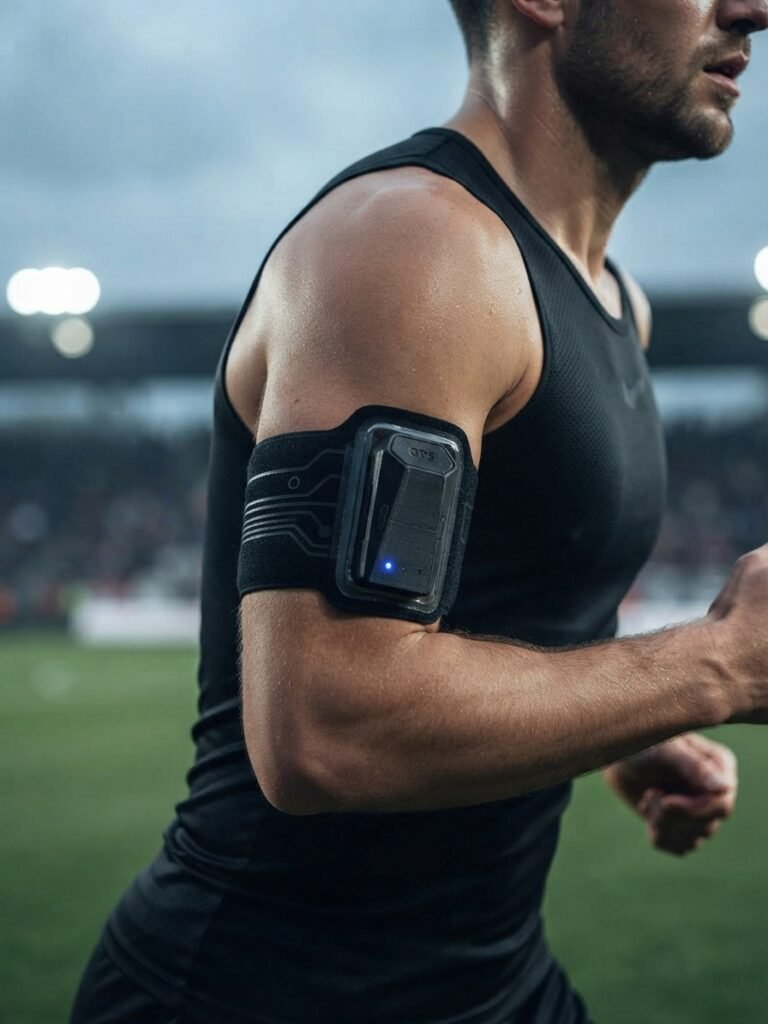 Worn in an armband
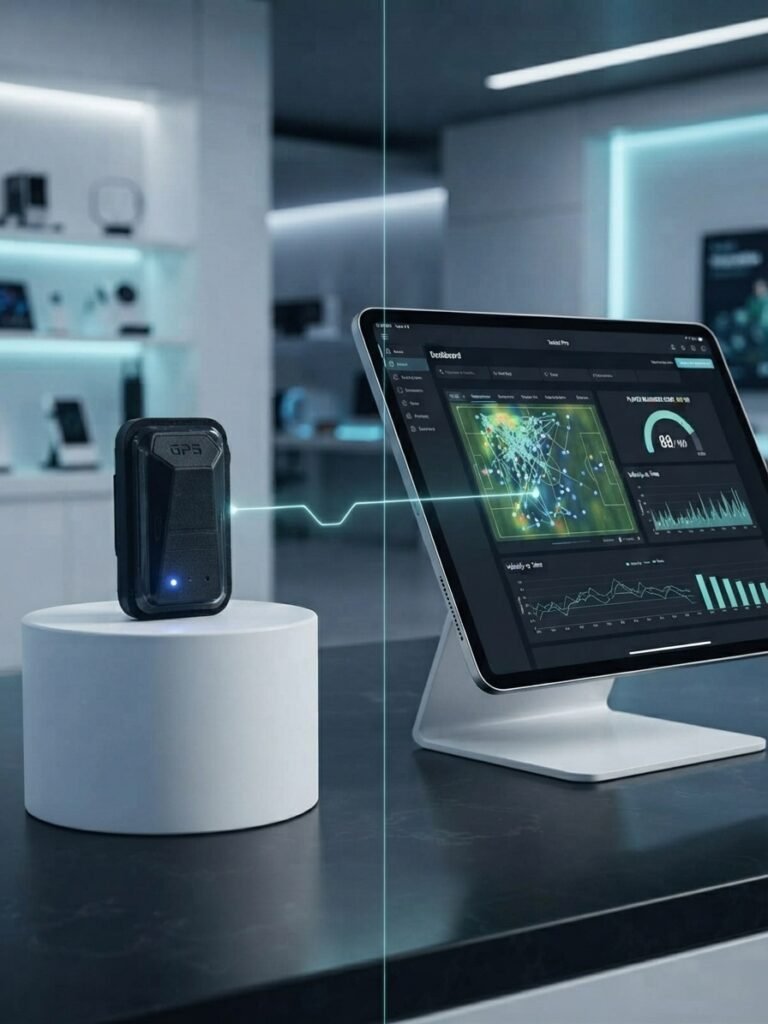 Live coach dashboard
A sealed housing that holds the board, the lithium pack and the SIM slot in one closed body.
One board for GPS, cellular, motion and Bluetooth, with power-saving modes so it lasts through training.
A dashboard for live position, session history and alerts, then working prototypes delivered.
Frequently asked questions
Is a 1 Hz GPS receiver enough for a sports tracker?
For distance over a session, often yes. For sprints, accelerations and top speed in team sports, usually no: a 1 Hz receiver sees one position per second and misses most of a short burst. Around 10 Hz GNSS plus a motion sensor is the common approach for athlete tracking.
Can a phone app replace a dedicated GPS tracker for athletes?
A phone works for running or cycling, where it rides in a pocket or on handlebars. In contact and team sports a phone is impractical to wear, its receiver usually updates slowly, and it has no motion data at the rate needed for sprint and impact metrics.
Should the tracker stream live data or sync after the session?
Sync after the session unless someone will act on the data during play. Live streaming adds a radio running all session, a receiver or data plan, and app work, and it shortens battery life. Many products start with log-then-sync and add live features once the core metrics are proven.
Do I need a multi-band GNSS receiver?
It helps most where signals reflect off structures, such as stadiums with high stands or urban venues. It adds unit cost and usually power draw. Test a single-band and a multi-band module in your real venues before deciding.
How many prototype iterations should I expect?
In our experience at Inventornest, we usually need two PCB development iterations, and a project may require four or five depending on complexity and the issues found. Trackers tend to need field tuning of antenna placement and motion algorithms, so budget time for testing between iterations.
How do I check a tracker’s accuracy claims?
Ask how the figure was measured: open sky or on a body, which wear position, which reference, and at what update rate. Then run your own field test against a measured course, timing gates and a reference receiver.
How Inventornest helps you build a GPS tracker
A sports tracker only earns trust when its numbers hold up on a real athlete, in a real venue, for a whole session. That depends on decisions made early: the GNSS module and update rate, whether motion sensing is included, where the device is worn, and how much battery the housing can carry.
At Inventornest, we always prefer to begin with feasibility, whether the idea is simple or complex. A technical feasibility analysis is where we pin down the metrics that matter, the wear position and the runtime target before any board is designed. Feasibility is not a guarantee that the product will work; component performance and battery runtime still need testing during prototyping, which is why we plan field tests from the start.
Our IoT product design services cover the device, firmware, app and cloud for connected products like trackers. With 200+ products built and 12+ years building hardware (since 2013), we know where tracker projects tend to need a second look. When you are ready to talk through your tracker, book a consultation.