Industries · Femtech
Femtech product development, from sketch to factory
Intimate wellness devices, pelvic floor trainers, fertility wearables and breast pumps touch the most sensitive parts of the body, and the rules for them are strict. We take femtech hardware from idea to factory: body-safe materials, precise heat and motor control, electronics and firmware, the right regulatory route from day one, and manufacturing with our partner factories in China and Pakistan.
- 200+ products built
- ISO 13485 certified
- Body-safe by design
- NDA before you share
The short answer
What is femtech product development?
Femtech product development turns an idea for a women’s health product into hardware that is safe, discreet and ready to sell. It covers body-safe materials, heat, vibration or suction that stays within safe limits, electronics and firmware, privacy for intimate data, the right regulatory route for what the product claims, and manufacturing at a price buyers will pay.
Where femtech projects go wrong
Four ways femtech projects stall
One health claim can make it a medical device.
We fix the claim and the route before the PCB.
ISO 13485 certifiedCheap plastics can leach into delicate tissue.
We specify body-safe silicone with test data.
ISO 3533Heat near intimate tissue needs hard limits.
We build closed-loop heat control and sensing.
Pretty Tight KittyCycle and intimacy data is a privacy target.
We keep data on the device unless it must move.
GDPR Art. 9Regulatory route
Which route is your femtech device on?
Pick where it touches, what you say it does and what it uses. The card shows the likely route and what to plan for.
1Where does it touch?
2What do you say it does?
3What does it use?
Likely route
Consumer product
What to plan for
Design to ISO 3533, phthalate limits, battery and water tests. A Kegel claim makes it Class II.
A guide, not regulatory advice. Your claims and labels decide the route.
What we build
Femtech devices we engineer
Intimate
Intimate wellness devices
Our projects
Pretty Tight Kitty (our project)
What matters most
Body-safe surfaces, steady heat and quiet motors.
Standards we design for
ISO 3533, ISO 10993-1, IEC 62133-2, IPX7
Pelvic
Pelvic floor trainers
Our projects
Pelvic floor trainers (we design for)
What matters most
Accurate pressure sensing, app feedback and comfort.
Standards we design for
21 CFR 884, ISO 10993-1, Bluetooth
Fertility
Fertility wearables
Our projects
Fertility rings and trackers (we design for)
What matters most
Skin-temperature accuracy, battery life and privacy.
Standards we design for
FDA wellness or 510(k), GDPR Art. 9
Postpartum
Postpartum devices
Our projects
Wearable breast pumps (we design for)
What matters most
Gentle suction, backflow protection and easy cleaning.
Standards we design for
21 CFR 884, IEC 60601-1-11, ISO 10993-1
Certification
The standards femtech devices must meet
ISO 10993-1 biocompatibility
What it covers
Body-contact materials and their biological tests.
What we do
We pick materials with biocompatibility data.
ISO 3533 intimate-contact products
What it covers
Safety and labels for intimate-contact products.
What we do
We design materials, shape and cleaning to it.
FDA 21 CFR 884 obstetric and gynaecologic devices
What it covers
FDA rules for obstetric and gynaecologic devices.
What we do
We map your claim to the right FDA device type.
IEC 60601-1-11 home healthcare
What it covers
Medical electrical safety for use at home.
What we do
We design for lay users, water and charging.
IEC 60335-2-115 skin-heating appliances
What it covers
Household appliances that heat the skin.
What we do
We hold output and surface heat inside limits.
IEC 62133-2 lithium cells
What it covers
Safety of rechargeable lithium cells and packs.
What we do
We specify cells and charging that pass testing.
GDPR Article 9 special-category data
What it covers
EU rule for health and sex-life data.
What we do
We design apps to collect and share the minimum.
Accredited labs and regulators decide. We design to pass and prepare test-ready samples.
Our own work
A featured femtech project, under NDA
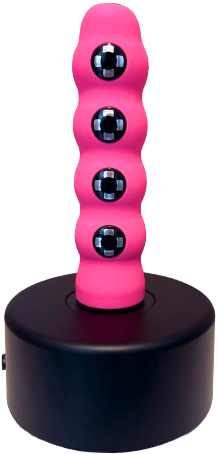
One of a kind: a handheld RF wand with closed-loop heat control.
- Bipolar RF heating
- 360° rotation
- Vibration motor
- Closed-loop temperature control
- Skin-contact sensing
Our scope
Engineering only. We make no health claims for this product.
Device types we design for
Skin-heating beauty devices are on our Health and wellness page.
How it runs
From idea to first production run
- 01FeasibilityRoute, target cost and test plan, with a fixed quote.
- 02Prototype (EVT)Body-safe samples that prove heat and motor control.
- 03Test and certify (DVT)Materials, heat, battery and water tests.
- 04Production (PVT)A pilot run, then volume with materials records for each batch.
Services we use
The teams behind every femtech device
What clients say
everything has exceeded my expectations for the development of my product.
they always deliver what is expected and work with me on smoothing out any details.
FAQ
Femtech questions founders ask us
Is a femtech device a medical device?
It depends on what you claim and how it works. Claims to treat or diagnose a condition make it a medical device. The FDA’s wellness policy covers low-risk products for things like sexual function, but not products that pierce tissue or use risky energy.
Is a vibrator or intimate device regulated by the FDA?
A vibrator sold for pleasure is usually a consumer product. Labelled to treat sexual dysfunction or to support Kegel exercise, it is a Class II device. The label decides the route.
Does a pelvic floor trainer need FDA clearance?
If it measures muscle strength for incontinence, yes. App-connected trainers have been cleared through 510(k) as perineometers. Some trainers are sold with wellness claims only.
Can a heat or RF intimate device be sold as wellness?
Be careful. The FDA’s wellness policy excludes products with energy risks, and in 2018 the FDA warned about energy-based vaginal devices. Get a regulatory review before you write any claim.
What does "body-safe" mean?
There is no legal definition. We use platinum-cured silicone with biocompatibility data and no restricted phthalates, and design intimate-contact products to ISO 3533.
How should a femtech app protect cycle or intimacy data?
Collect less, and keep it on the device where possible. In the US, the FTC’s Health Breach Notification Rule covers health apps. In the EU, health and sex-life data is special-category data under GDPR.
Do you design breast pumps?
We design for them. Powered breast pumps are FDA Class II and need a 510(k). Plan suction, backflow, cleaning and battery testing from day one.
How much does femtech product development cost?
It depends on materials, heat or motors, apps and the regulatory route. A feasibility study at $1,000 to $2,000 gives you a fixed price per stage, including the materials and heat tests.
Related guides
Before you build
Free product call
Building a femtech product the market hasn’t seen yet?
Book a free 30-minute product call. An engineer will tell you which route your device is on, what it takes to build it safely, and what it should cost per unit.
Tell us about your idea
Share as much or as little as you like. An engineer reads every enquiry and replies within one business day, under NDA before you share details.