

You have a working prototype, and someone has just told you it isn’t an MVP.
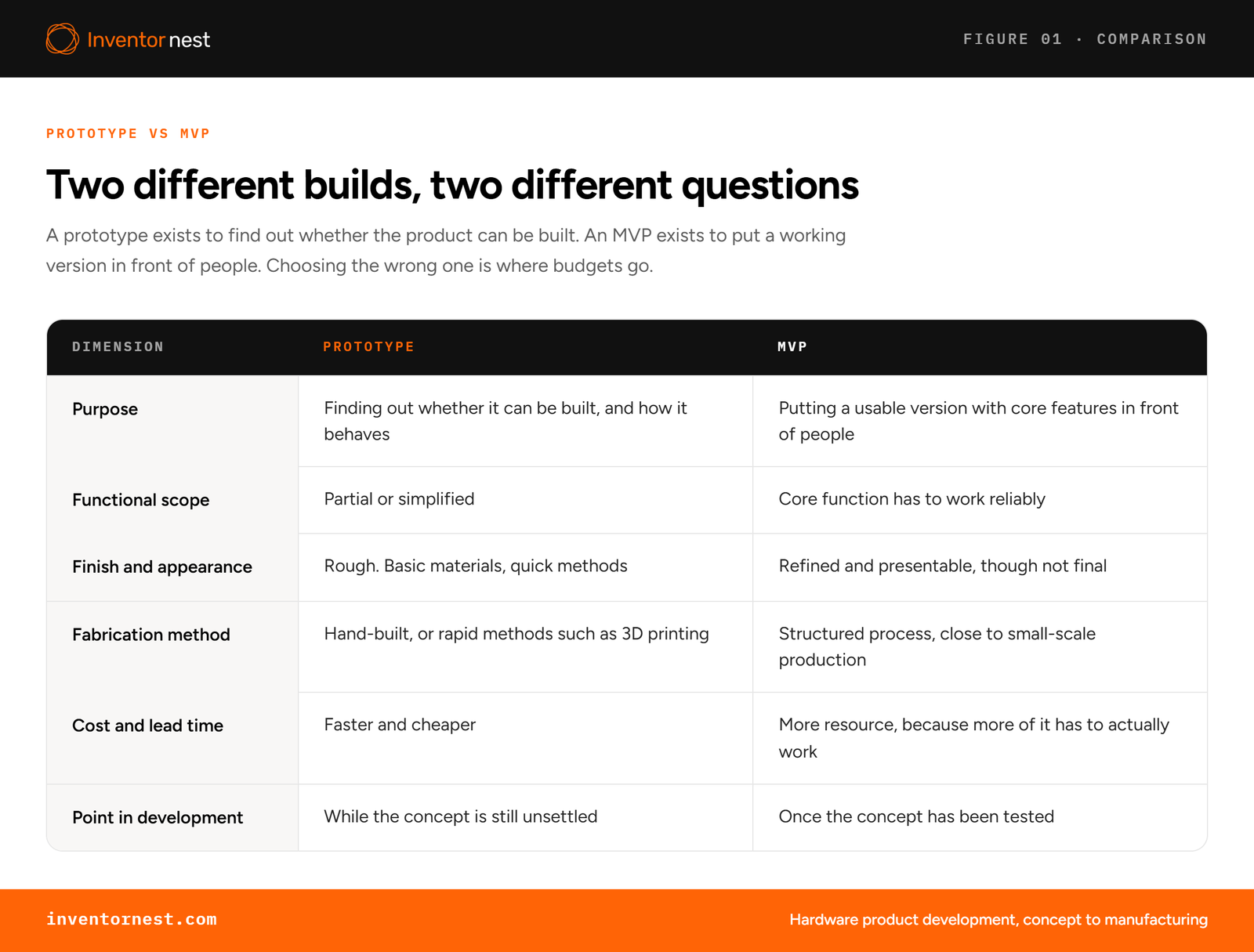
Here’s the difference in one line. A prototype proves your product can be built. An MVP proves people will pay for it.
In software those can be the same object, because shipping and iterating cost almost nothing. In hardware they can’t be — and the reason is expensive. Your prototype answered whether the thing works. It told you almost nothing about whether a factory can make it, at a price that leaves you a margin, ten thousand times over.
That second question is where the money goes. This guide covers where a prototype and an MVP actually sit in hardware development, what each stage costs, and how to tell which one you need next.
Prototype vs MVP: the two kinds of “viable” in hardware
In software, “viable” means one thing: people want it. If they want it and it runs, you ship.
In hardware, viable means two separate things, and they’re independent of each other.
Customer viability. Your product solves a real problem and somebody will pay for it. This is what a minimum viable product tests.
Manufacturing viability. A factory can produce it repeatedly, at a target cost, with ordinary operators and no heroics. This is what design for manufacturing, tooling and production validation test.
Here’s the part that catches founders. You can pass the first test completely and fail the second. The demo lands. Pre-orders come in. Then your manufacturer tells you the enclosure can’t be molded as drawn, or your unit cost comes back at three times the retail price you already announced.
By then you’ve cut tooling. The money is gone.
That’s why “build an MVP and iterate” travels badly from software to hardware. The advice isn’t wrong. It quietly assumes manufacturing viability is free, and in hardware it’s the expensive half.
POC, EVT, DVT, PVT: the hardware development stages your manufacturer uses
Nobody warns you about this: “prototype” and “MVP” are founder words. Your contract manufacturer doesn’t use them.
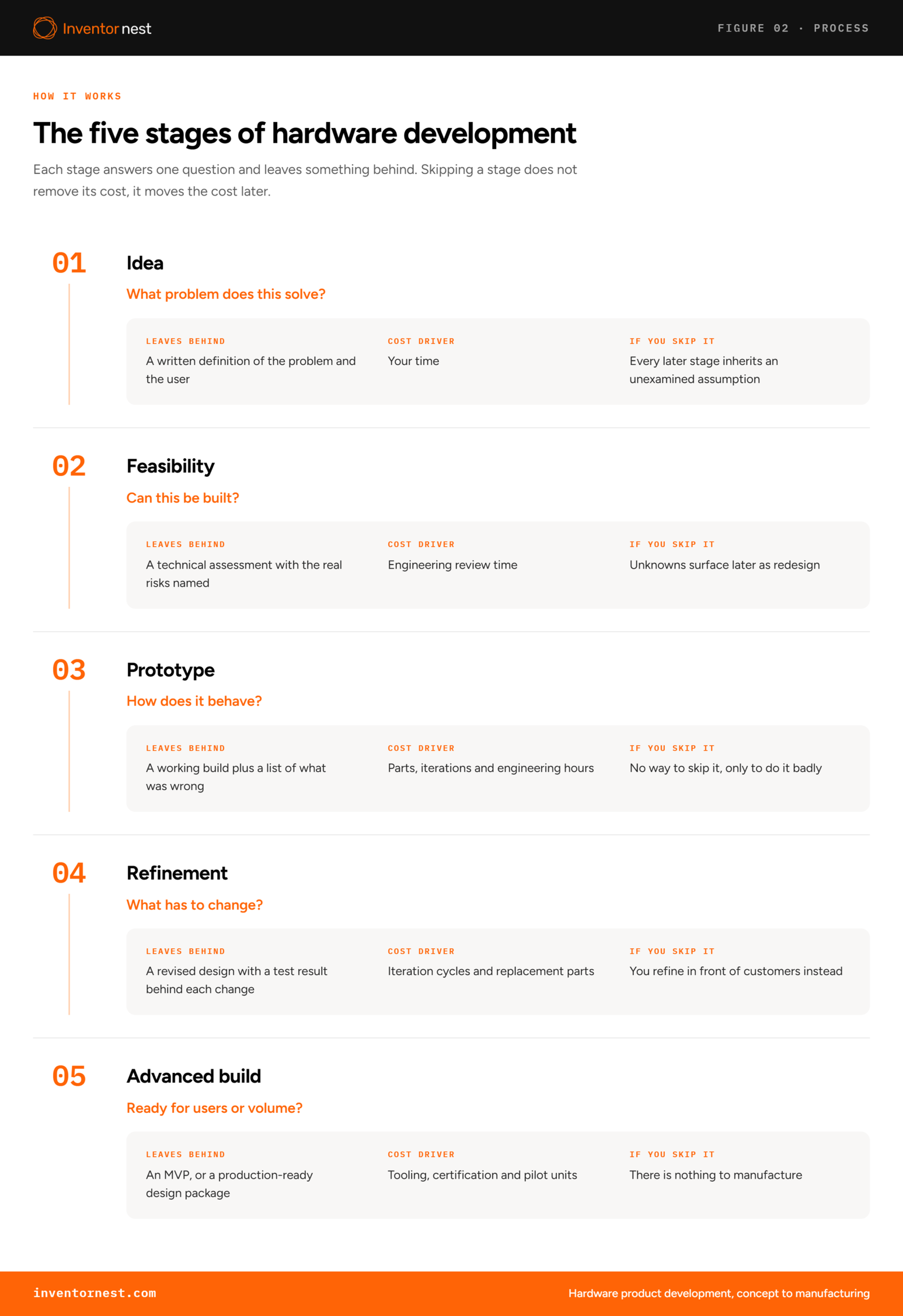
They work off a five-stage new product introduction ladder. If you can’t speak it, you’ll misread every quote and schedule you’re sent — and you’ll sound green in a conversation where sounding green costs money.
POC — proof of concept. Does the riskiest technical assumption hold at all? One or two units on dev kits and breadboards. It won’t look like your product and barely behaves like it. Its job is to kill a bad idea cheaply.
EVT — engineering validation test. Do the real components do what the spec says? Contract manufacturers who run these builds put this at 20 to 50 units over four to five weeks. The build works but looks rough. And here’s the number worth sitting with: up to 40% of EVT units can fail. That isn’t a disaster, it’s the stage doing its job. You couldn’t have found those failures at proof of concept, because a POC has no real bill of materials, no custom circuit board, and no enclosure trapping heat around the electronics.
DVT — design validation test. Will it survive the real world and pass certification? Fifty to 200 units, eight weeks minimum, built with production-capable processes rather than 3D printing. Environmental testing, EMC, drop, vibration and ingress protection happen here. Certification samples get reserved here. Suppliers sign off on long-lead components here.
This is also the stage teams cut when the schedule slips, and the one that punishes them for it.
PVT — production validation test. Can the line build it at yield, with ordinary operators? Usually 5 to 10% of your first production run. What comes out is a validated line and units you can actually sell. The design is locked — a real change here sends you back to DVT.
MP — mass production. The validated line at full rate.
Now map your two words onto that ladder. A prototype lives at POC and EVT. An MVP — something a customer buys, keeps, and expects to work — lives at PVT, because until then you can’t repeatably build a sellable unit.
They aren’t two options on a menu. They sit at opposite ends of the same project.
How long is that project? Realistically 18 to 24 months from concept to volume. Published industry timelines put the fastest possible case at about a year, allow six to nine months after your final prototype just to reach manufacturing readiness, and treat two years as more honest for most first-time teams.
Why you can’t iterate a hardware product the way you iterate software
Every founder from a software background says some version of this: ship it, see what breaks, fix it next quarter.
In hardware, “fix it next quarter” has a price list. Here’s what’s on it.
There’s no patch. You rebuild. A change means new parts, and often a new injection mold.
Tooling only moves one way cheaply. The moldmaker’s rule is maximize metal, minimize plastic. You can add plastic to a part easily, because that means cutting steel out of the mold — thickening a wall, growing a boss, shrinking a hole by adding material around it.
You can’t easily remove plastic, because that means putting steel back, which usually means new mold inserts. So slimming your housing is a new tool. So is making a hole or a USB cut-out bigger, even though that feels like making the part smaller.
Tooling shops price a new mold from roughly $2,000 for something simple to over $100,000 for something complex. Molders quote normal injection mold tooling lead times at 45 to 65 days from order to first shots — call it six to ten weeks.
So “we’ll just make it a bit slimmer in v2” isn’t a tweak. It’s a new tool and most of a quarter.
Switching resin usually forces new tooling too. Your mold was cut oversize to match one plastic’s shrinkage rate. If the replacement shrinks more, steel can sometimes come out to compensate. If it shrinks less, or the part lands outside tolerance, you’re cutting a new cavity and core.
Which tooling you bought decides how many mistakes you have left. Aluminum tooling starts around $1,500 a mold and typically lasts a few thousand parts — tens of thousands only with hardened alloys and non-abrasive resins. Multi-cavity steel tooling runs $10,000 to $50,000 a mold and lasts hundreds of thousands to millions.
Aluminum is what you buy while the design is still moving. Steel is what you buy once it’s stopped. Cutting steel too early is one of the most expensive mistakes available to a hardware startup.
A cosmetic change can put your certification back in play. Enclosure material sits high on every EMC engineer’s re-test risk list, alongside PCB and embedded system design changes like board stack-up, power supply modifications, added ports, and swapping a component for one that switches differently.
Formally, the FCC treats post-certification changes as Class I or Class II permissive changes. An enclosure change that genuinely doesn’t affect RF performance may need no new filing. One that does means new test data before you can sell. That judgment call is yours to defend.
For scale: published industry cost breakdowns put total certification at roughly $3,000 to $8,000 if you’re built on pre-certified modules and batteries, and well over $50,000 for a custom radio or battery design.
And every dollar added to the bill of materials gets multiplied at retail. The common rule of thumb — which hardware venture investors cite while warning against pricing off it — is retail at 2.5 to 4 times BOM cost. A $1 part added late becomes $2.50 to $4 on the shelf. That stops being an engineering decision and becomes a pricing decision.
Underneath all of it is one problem: feedback comes too late. In software your loop closes in a sprint. In hardware it closes after the tool is cut, which is after the money is committed. Investors who fund hardware call it the long shadow — early decisions don’t show their real cost until the first shots come off tooling.
What a working prototype cannot tell you about manufacturing
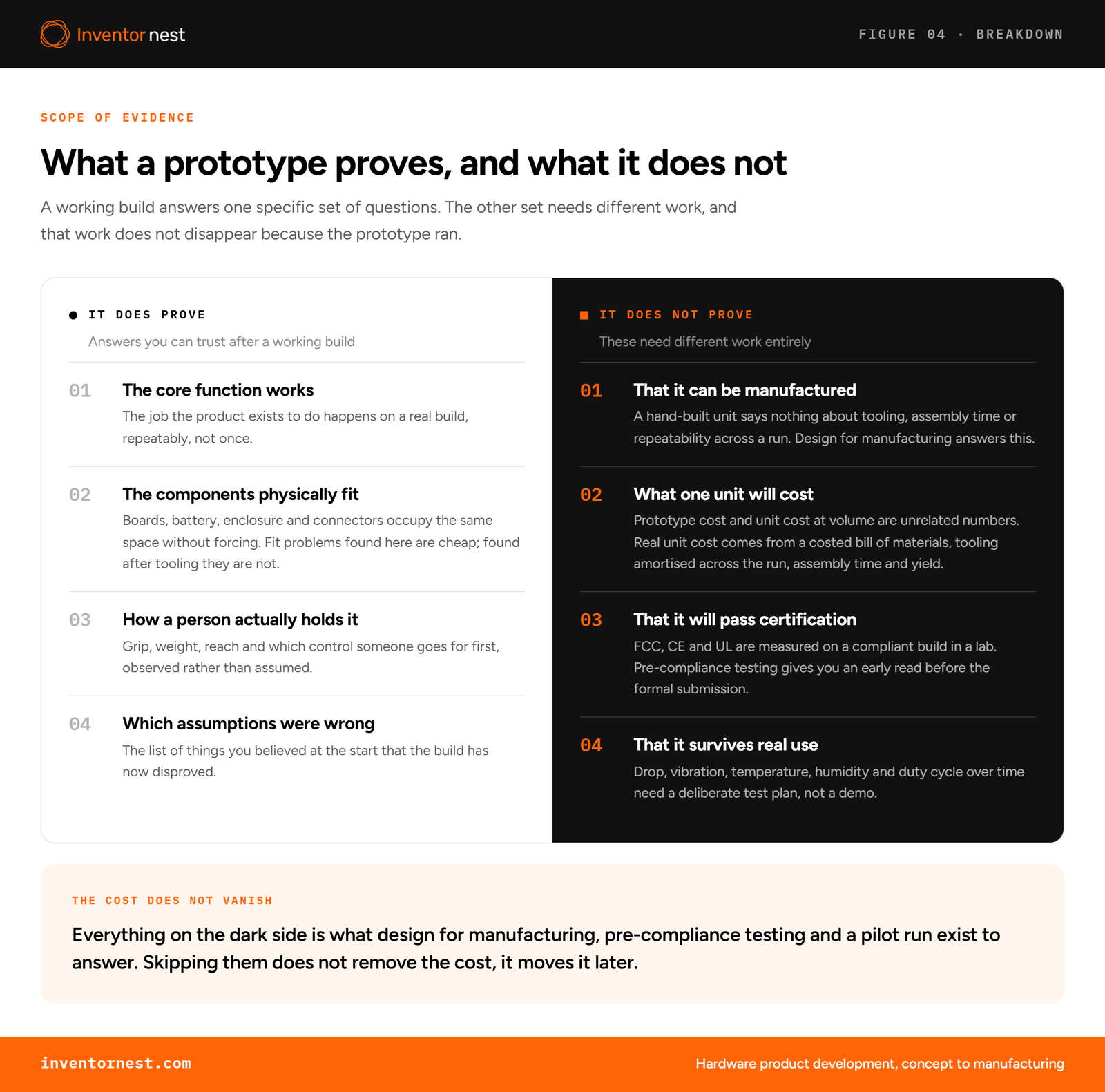
A prototype that switches on and does its job feels like proof. It proves one thing. Here’s what it stays silent about, and why.
Whether it can be manufactured. Your prototype was made by a process that shares almost none of production’s rules.
A 3D printer doesn’t care about draft angles, uniform wall thickness, ejection, gates or parting lines. It shrinks — SLS nylon by around 3 to 4% — but you fix that by scaling the file, not by re-cutting a tool.
Injection molding cares about every one of those. Vertical faces need at least 0.5° of draft, usually 1 to 2°, rising to 3° for a light bead-blast texture and 5° or more for a heavy one. Skip the draft and parts warp, scratch on ejection, or stick and damage the mold itself.
Your prototype proves the geometry can exist. It says nothing about whether that geometry can be pulled out of a steel cavity a hundred thousand times. That gap is what design for manufacturing closes.
What each unit will cost at volume. Prototype cost and cost of goods sold are two different sums. Prototype cost is mostly setup and small-batch pricing. Production unit cost is tooling amortized across the run, cycle time, cavitation, component price breaks, and yield.
Neither your prototype’s cost nor its raw parts list predicts your COGS, because volume pricing gets negotiated later and assembly time only gets measured at production validation.
Whether it will pass certification. Electromagnetic emissions are a property of the whole physical assembly: board stack-up, cable routing, enclosure material, shielding, power topology. Your hand-built prototype has a different version of every one.
That’s exactly why EMC pre-compliance scanning belongs at EVT and formal certification samples get reserved at DVT — so you find out while you can still change something.
Whether it survives. Your prototype performed under nice conditions, at one moment, with a sample size of one. Reliability is a distribution across stress and time. You only see it by putting a population through combined stress — thermal cycling, vibration, shock, damp heat at 85 to 93% humidity, power cycling, overload — the way real life applies them, all at once.
With one unit you can’t produce a failure rate. You can only produce a story. Our prototype testing checklist covers what to put a build through before calling it finished.
And the one almost nobody plans for: yield and assembly time. These belong to the production line, not the design, so no prototype can contain them.
Published supply chain analyses of scaling give two examples worth remembering. A connector that needs a small wiggle at low volume can turn into a 4% failure rate at scale. A 30-second assembly step your engineer does without thinking can become a three-minute bottleneck on a line.
Those small fixes never get written down, so the factory never learns them.
Do you need a prototype or an MVP?
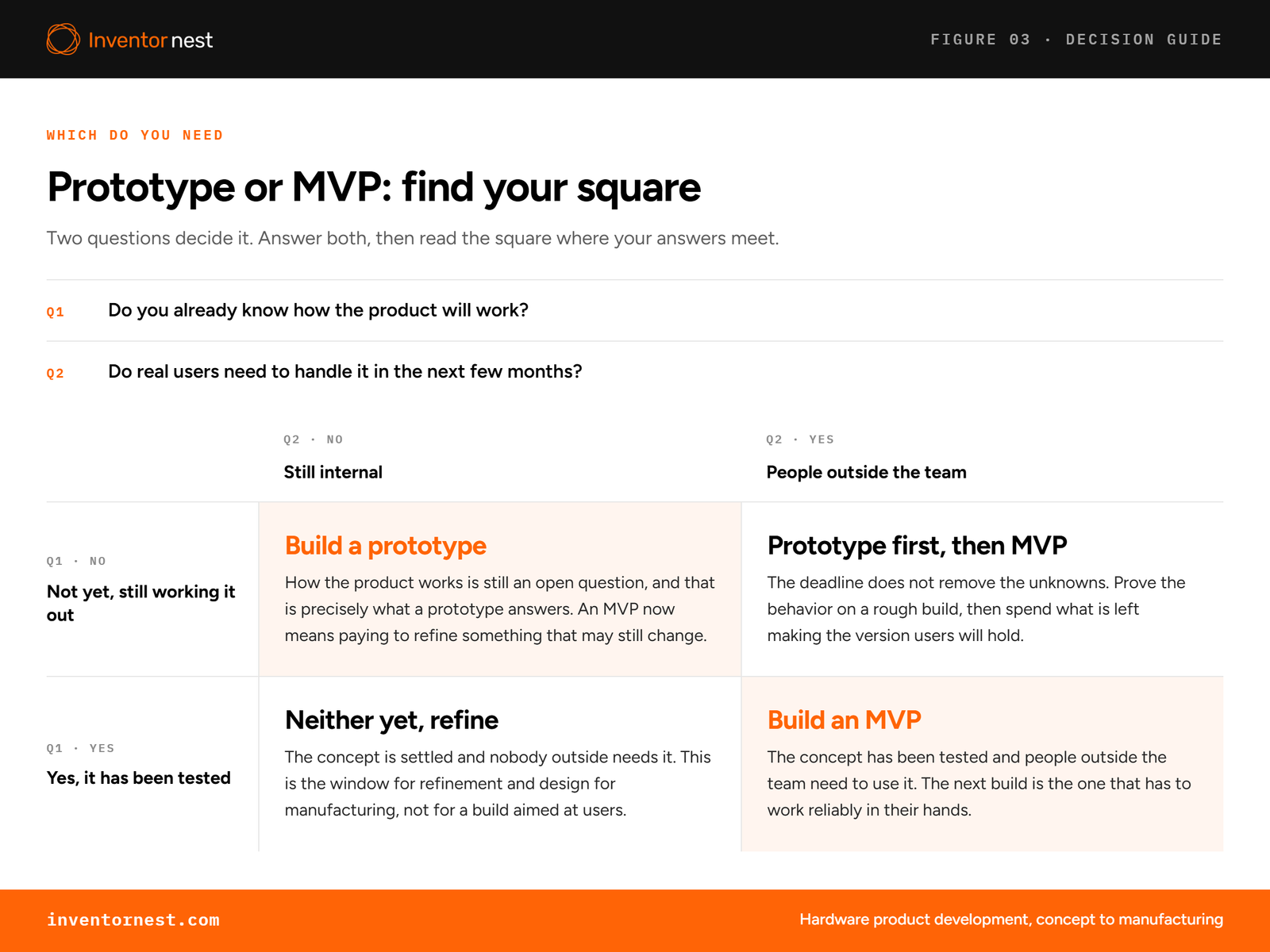
Two questions settle it, and neither is about how polished the thing looks.
Do you already know how your product works?
If the mechanism, the power budget or the sensor accuracy is still an open question, you need a prototype — whatever your timeline says. Building an MVP on an unsettled concept means paying to refine something that’s still going to change.
If you’re earlier than that and the concept itself is unproven, product feasibility analysis comes before either one.
Do real users need to hold it in the next few months?
If yes, and your concept is already tested, you’re heading up the production ladder. Start planning design validation and tooling, not another bench build.
And if the concept is settled but nobody outside your team needs it yet, you’re standing in the most valuable window in the whole project: design for manufacturing and validation. It’s neither a prototype nor an MVP, it’s the least glamorous stage, and it’s the one that pays for itself.
When an MVP does make sense for a physical product
None of this makes MVP thinking useless in hardware. It changes what you use it for: a scoping tool, not a shipping strategy.
The useful version works like this. Every feature you add costs four things — development money, development time, unit cost, and one more thing that can fail quality control. Rank your features by what customers actually care about, price each against those four, keep the cheap and important, cut the expensive and marginal.
On that basis, a year on a focused product genuinely beats three years on a complete one.
What “minimum” must never mean in hardware is less safety, less reliability, or a core function that half-works. It means fewer ports, less cosmetic polish, and manual where automatic isn’t critical. And a hardware MVP has to answer a question software never asks: can this actually reach production?
There are real exceptions, and you might be one. Low-volume industrial and instrument products — scientific equipment, specialist sensors, capital hardware — sell profitably at tens or low hundreds of units a year, machined and printed and hand-assembled. They never see a production validation run, and this whole tooling argument doesn’t apply to them.
Crowdfunding backers, paid beta customers and dev-kit buyers also take pre-production units on purpose, knowing exactly what they’re getting.
What every exception shares is a customer who has agreed to be early. So the failure isn’t selling before you’re finished. The failure is selling pre-production hardware to someone who thinks they’re buying a finished product.
Three things to change in your development plan
Budget for validation, because it’s the first thing you’ll want to cut. Design validation is the hardest stage and the one that gets squeezed when you’re behind. What gets skipped there — in-circuit test coverage, user testing on production-intent units, supplier agreements on long-lead parts — comes back at production validation or during the ramp, when fixing it costs the most.
Treat component availability as a design decision, not a purchasing detail. Parts behave differently at volume than on your bench. Supply chain reporting has documented a team that lined up its contract manufacturer and then found its sole-sourced power management IC carried a 52-week lead time. Some components run 6 to 18 months, and your order queues behind customers buying millions a year.
Don’t count on the factory to fix your design. Factories build what you give them. If your design isn’t manufacturable you don’t get a correction — you get a yield problem, a quality problem, or a quote you can’t afford. Which is why it pays to know how to find the right manufacturer for a hardware product before you need one.
How Inventornest approaches prototype and MVP decisions
We’d rather meet founders while these decisions are still cheap to change, which is earlier than most people think to call.
In practice that means testing the riskiest assumption before anything gets built, instead of discovering it at engineering validation. It means designing the enclosure for the process that will actually make it — draft, wall thickness and parting lines settled before anyone quotes tooling.
It also means selecting components against real lead times, so the bill of materials that works in the lab still works at volume.
The goal was never a working prototype faster. It’s a prototype whose answers still hold when you scale it. That’s what our product prototyping services are built around.
Not sure whether you need a prototype, an MVP, or the validation work in between? Book a consultation and we’ll map your product against the stages, so you know what has to be true before you write the next check.
Prototype vs MVP: frequently asked questions
Is an MVP the same as a prototype?
No. A prototype tests whether your product can be built and how it behaves. An MVP tests whether customers will adopt it and pay for it. For anything headed to volume production they also sit far apart in the schedule: a prototype is the engineering validation stage, while something a customer buys and keeps arrives at production validation, because until then you can’t repeatably build a sellable unit.
Can you build an MVP for a hardware product?
Yes, as a way to decide scope rather than a way to decide when to ship. It works for cutting extra ports, cosmetic polish and non-critical automation. It works badly as permission to ship early and fix later, because fixing a physical product after tooling usually means new tooling. Low-volume industrial products and knowingly pre-production sales such as crowdfunding are the genuine exceptions.
How much does a hardware prototype cost?
It depends which kind you’re building. Industry cost data puts a proof of concept at typically under $1,000, a looks-like model at roughly $500 to $5,000, a works-like prototype with your first custom circuit board at $5,000 to $50,000 or more, and one that both works and looks right at $10,000 to $100,000 or more.
How long does it take to go from prototype to production?
Realistically 18 to 24 months from concept to volume, with about a year as the fastest case and roughly six to nine months from a final prototype to manufacturing readiness. Engineering validation takes four to five weeks, design validation around eight, and production validation several more — before tooling lead time, which adds six to ten weeks for a new injection mold.
What comes after a prototype in hardware development?
Design validation, then production validation. Your prototype is the EVT stage. Next is DVT, where the product is built with production-capable processes and tested against real environments and certification requirements. Then PVT, where the factory proves it can build your design repeatably at yield.
Do I need a prototype before approaching a manufacturer?
You need enough that the conversation is about manufacturing rather than invention. Factories build what you give them; they don’t fix designs. A prototype plus a design that has been through design for manufacturing gets you a useful quote. A prototype on its own often gets you a quote that changes substantially once the real constraints surface.
Does changing a hardware product after tooling really cost that much?
It depends which direction you’re changing. Adding plastic is usually cheap, because it means removing steel from the mold. Removing plastic — slimming a part, enlarging a hole or a port — means adding steel back, which usually needs new inserts. Switching resin normally forces new tooling because shrinkage rates differ. And some changes, including enclosure material, power supply and board stack-up, can put your certification back in question.
What is the difference between EVT, DVT and PVT?
EVT asks whether the engineering works, on 20 to 50 units over four to five weeks. DVT asks whether the design survives the real world and passes certification, on 50 to 200 production-intent units over at least eight weeks. PVT asks whether the factory line can build it repeatably at yield, on 5 to 10% of the first production run.