

Four kinds of people can help you build a product idea: engineers who solve one defined technical problem, design and engineering firms that carry a product across disciplines, manufacturers who build a design you already own, and government-funded programs that cost little or nothing. Which one you need depends on how far along your idea is, and the honest answer for most first-time inventors is that they need the least expensive kind first.
Thank you for reading this post, don't forget to subscribe!There is also a fifth category that advertises hardest, charges the most upfront, and has the worst documented record of any of them. That one is covered further down, because it is the mistake that ends the most inventions.
What people usually mean when they ask this
The question almost always carries one of three worries underneath it.
- “I can’t build this myself.” You need engineering skill you do not have.
- “I don’t know if it’s any good.” You want someone qualified to tell you whether the idea works before you spend real money.
- “I don’t know who to trust.” You have found companies online, they all sound the same, and several of them want money before they will say anything specific.
Those need different answers. The first is a hiring problem. The second is a feasibility problem. The third is the one this article can help with most, because the difference between a real engineering firm and a sales operation is visible in the first conversation once you know what to listen for.
The types of help that actually exist
Engineering and design help
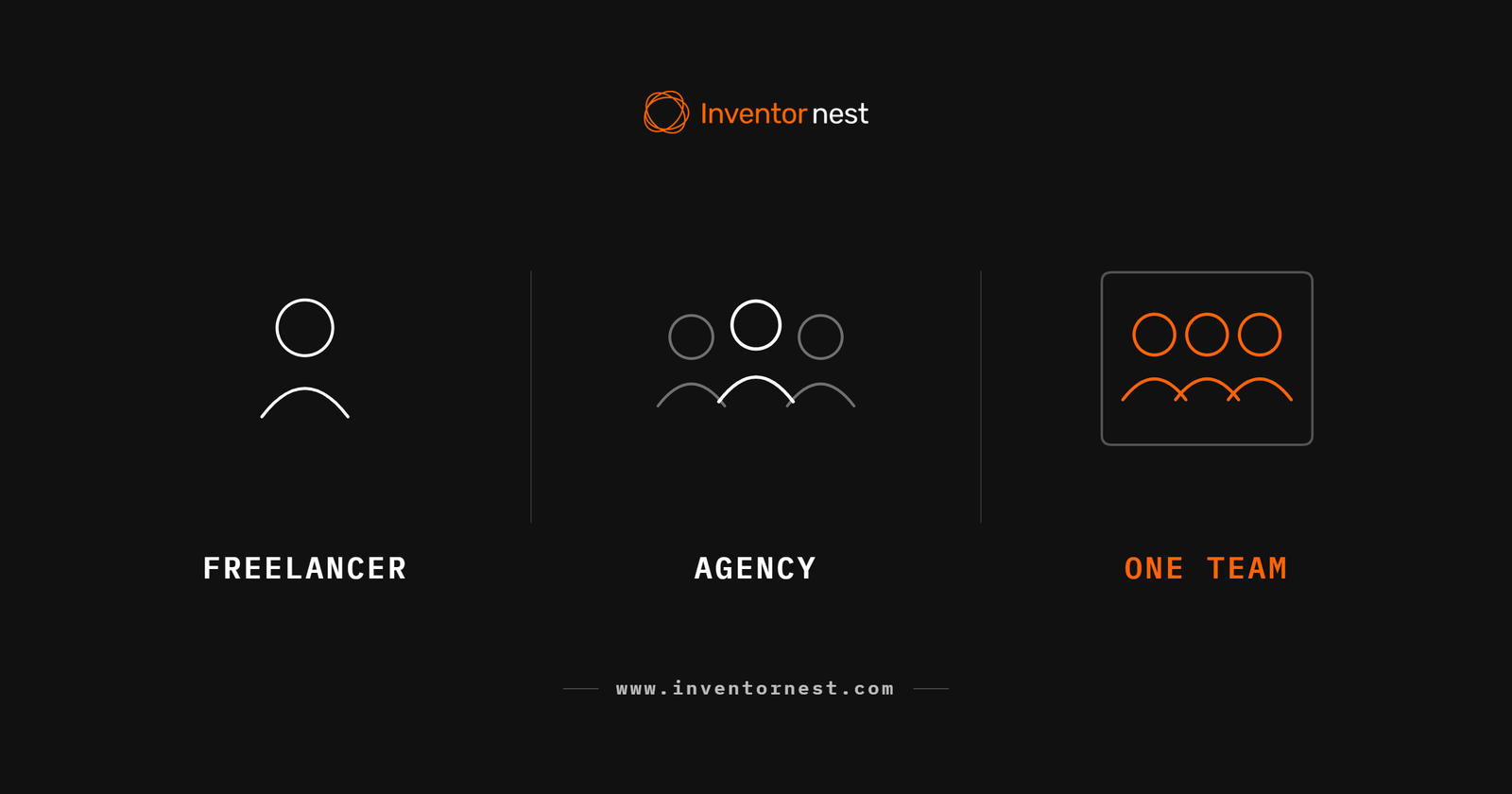
A freelance engineer or independent contractor takes on discrete, bounded tasks: a CAD model, a PCB schematic, firmware for one subsystem, one prototype iteration. They will not carry a multi-discipline project, manage suppliers, or provide continuity if another client takes their time. Right when you have one clearly defined gap and can specify the deliverable yourself.
An industrial design studio handles form, ergonomics, materials, finish and how the product is used. The Industrial Designers Society of America describes industrial designers as working within multidisciplinary teams alongside engineers, and that division is the point: a studio produces how the product looks and feels, and engineers produce whether it works. A beautiful rendering is not an engineered product. Confusing the two is the single most common and most expensive beginner mistake in this category.
A product development firm carries a project across industrial design, mechanical, electrical, firmware and testing, through to design transfer to a manufacturer. It does not manufacture at volume, fund your project, or sell your product. Right when your product needs several disciplines and you cannot personally integrate them.
Manufacturing help
A contract manufacturer or EMS provider builds to your documentation. It owns no design IP and sells capacity, procurement and assembly. It will not design your product or repair an incomplete design package, and this is the trap: a factory will happily quote an unfinished design and then build exactly what you documented, mistakes included.
An ODM already owns a design, adapts it for you and manufactures it. Fastest and cheapest when something adjacent already exists. Unless you explicitly purchase the intellectual property, the ODM keeps it and can sell the same design to anyone else.
A sourcing agent finds, qualifies and manages factories for you. They do not design or hold technical accountability. Ask one question before hiring one: who pays you, and how? An agent paid by you, an agent paid by the factory, and an agent on commission against order value have three different sets of interests.
End to end help
Some firms carry a product from concept through to a manufactured unit, either by doing the engineering and managing the factory, or by doing both. This is the most expensive route per hour and often the cheapest per outcome, because the handoffs are where hardware projects lose money.
Help that costs almost nothing
This category is real, underused, and entirely government funded.
- NIST Manufacturing Extension Partnership. Administered by the US Department of Commerce, with nearly 1,400 advisors across more than 450 service locations in all 50 states and Puerto Rico. Services include supplier scouting, which is exactly the problem most inventors are trying to solve. Services are cost shared rather than free, and there is a center locator on the NIST site.
- SBA resource partners. Small Business Development Centers, SCORE mentoring, Women’s Business Centers and Veterans Business Outreach Centers offer counseling and training, most of it free. Listed at the SBA resource partners directory.
- USPTO Patent Pro Bono Program. A national network matching volunteer patent attorneys with under-resourced inventors, providing free preparation and filing of a patent application. Eligibility generally requires gross household income under three times the federal poverty guidelines and a demonstration of patent knowledge, though the specific requirements vary by regional program. Details at the USPTO patent pro bono program.
- University and community fab labs. Widespread, often equipped with 3D printers, laser cutters and CNC machines. Access rules vary enormously: many campus facilities are open to students only, while community fab labs and library makerspaces are usually open to the public.
The one category to be careful with
Invention promotion companies sell evaluation reports, “submission” services and the promise of getting your idea in front of manufacturers. They advertise heavily to inventors, charge upfront, and the enforcement record against them is unusually well documented.
Congress legislated specifically about them. Under 35 U.S.C. 297, an invention promoter must give you five things in writing before you sign:
- How many inventions it has evaluated in the past five years, split into positive and negative evaluations
- How many customers it has had in the past five years
- How many of those customers it knows to have made a net financial profit as a direct result of its services
- How many it knows to have received license agreements as a direct result of its services
- Every invention promotion company it has been affiliated with in the previous ten years
Item three is the one that matters. Ask for it in writing, and read the number. Note the statute only requires what the promoter knows, so a low number is damning and a high one still needs checking.
The court record shows what those numbers tend to look like. In 2006 a federal court in Pennsylvania recorded one promoter’s own required disclosure: it said it was aware of 30 projects licensed and 10 that had produced financial gain to the project owner, since 1990. The FTC separately found that fewer than one percent of that firm’s customers earned royalties exceeding what they had paid. In 2007 a federal court in Virginia found that another firm, which took fees of $895 to $1,295 for evaluations and $5,000 to $45,000 for licensing services from 17,000 consumers, had never had a single client successfully market an invention. The judge called it “one grand con game.” The judgment was $61 million.
The most recent large case is instructive in a different way. A 2018 FTC settlement imposed a $25,987,192 judgment against World Patent Marketing and banned its operator from invention promotion for life. The judgment was then suspended down to roughly $1.05 million on the defendants’ ability to pay. When refunds went out in 2020, 5,503 consumers shared just over $1 million: an average of about $185 each. Even a complete regulatory win rarely gets an inventor’s money back.
What to check, and what checking will not tell you
The USPTO publishes complaints against invention promoters, along with the firm’s response. It is worth searching. It is also worth knowing its limits, which the government states plainly: the USPTO does not investigate the complaints and does not participate in legal proceedings. Complaints are removed three years after publication. The agency’s own paperwork estimate puts the volume at about 22 complaints a year, and it expects that to rise. As of mid-2026 the published list held four complaints across two firms.
An empty result therefore tells you very little. Search it, and do not treat a clean record as a clean record.
The warning signs regulators publish
Taken from FTC and USPTO consumer guidance:
- Promises of profit without genuine market evidence, or any guarantee of success
- Claims of special manufacturer relationships that require an upfront payment to access
- Large advance fees rather than compensation tied to your outcome
- Enthusiastic evaluations given to every inventor
- Promises of a “global patent,” which does not exist
- References who turn out to be connected to the firm, and online reviews that may be fabricated
- Reluctance to state the total cost before you sign
- Legal threats against customers who ask for a refund or complain publicly
The FTC’s own four questions are a good script: what is the total cost before I sign anything, who conducts the market research, will these promises be in writing, and does the firm make its money from upfront fees or from licensing royalties. Complaints go to ReportFraud.ftc.gov.
What you need before anyone can help you
You do not need a prototype, a patent, or a finished design. You do need enough definition that an engineer can give you a number instead of a guess.
- The problem, stated without the solution. What goes wrong today, for whom, and how often.
- Who it is for. A specific user, not “everyone.”
- Must-have versus nice-to-have functions. Separated, in writing. This one list changes quotes more than any other.
- A target price and a rough volume. Hundreds and hundreds of thousands are different products, not the same product at different scales.
- Your timeline and your budget. Real ones. A firm that knows your ceiling can tell you what fits inside it.
- Anything you already have. Sketches, a rough model, a filed application, test data.
This mirrors what regulated industries formalize as design inputs: define the intended use and the needs of the user before designing anything. If you cannot fill in that list yet, that is the work to do first, and a product feasibility analysis exists precisely to produce it.
What a first conversation should look like
A real engineering firm narrows the scope of your project. A sales operation expands it. That difference shows up within twenty minutes.
| What you see | Engineering firm | Sales operation |
|---|---|---|
| Reaction to your idea | Asks what it has to do, for whom, at what price | Tells you it has great potential |
| Scope | Narrows it, and says what they will not do | Expands it, and says they do everything |
| Requirements | Wants them written down before quoting | Quotes off your enthusiasm |
| How they get paid | For engineering work, against defined deliverables | Large fees upfront, before anything is built |
| The team | Named engineers with checkable backgrounds | “Our team of experts” |
| When you don’t fit | Refers you elsewhere | Never happens |
One credential is verifiable in two minutes. Only registered patent practitioners may represent you before the USPTO, and the Office of Enrollment and Discipline maintains a public roster of patent attorneys and agents. If a firm implies it will handle your patent, the person doing that work must be on that list. Checkable, and binary, which is rare in this field.
On NDAs
Practice varies, and anyone who tells you there is a single rule is overstating it. Engineering and product development firms commonly sign mutual NDAs, and many keep a standard version ready. University technology transfer offices generally advise keeping a first conversation general enough that no NDA is needed, and requesting one when the discussion turns specific and proprietary. Investors frequently decline to sign before a first meeting.
Worth knowing separately: US patent law includes a one-year grace period at 35 U.S.C. 102(b)(1)(A) for disclosures made by the inventor, described in MPEP 2153. That is a safety net rather than a strategy, it applies to US rights, and many other countries treat public disclosure very differently. This is general information and not legal advice; talk to a patent attorney about your own situation.
Who you do not need yet
- A factory, until you own a complete, released design package
- A patent attorney, until you know what the invention actually is. Building usually teaches you that
- A licensing agent, until something works
- A marketing company, until there is a product to market
Your next step
Write the list in “what you need before anyone can help you” and see how far you get. The gaps are your brief. If most of it fills in easily, you are ready to talk to an engineering firm. If it does not, start with feasibility, or with one of the free government resources above, and save the engineering budget for when it will buy you something.
Frequently asked questions
I have an idea for a product. What do I actually do next?
Define it before you build it. Write down the problem, the specific user, the must-have functions, a target price and a rough volume. That document is what turns a conversation with an engineer into a quote rather than a guess.
Do I need a patent before I talk to anyone?
Usually no, and often you cannot write a good application yet because you do not know precisely what the invention is. Engineering and product development firms routinely sign mutual NDAs for early conversations. Speak to a patent attorney about the timing for your situation.
How much does it cost to get help building a product?
It varies by orders of magnitude depending on discipline count and whether the product has electronics, a radio, or a battery. The shape of the spend is consistent: concept and feasibility are the cheapest stage, engineering is the largest labor cost, and tooling is usually the single biggest jump.
Are invention promotion companies always a scam?
Not by definition, and the statute regulating them contemplates legitimate operators. The documented record is poor and the disclosures required under 35 U.S.C. 297 are the fastest way to assess any particular firm. Ask how many customers made a net financial profit, in writing, before signing.
What is the cheapest way to find out if my idea is worth pursuing?
Free government resources first: an SBA resource partner for the business side, a NIST MEP center for the manufacturing side. Then a paid feasibility assessment before any engineering spend.
Where Inventornest fits
Inventornest works with inventors and non-technical founders from the definition stage onward, which means the first conversation is usually about whether the idea is ready rather than what it would cost to build. We will tell you when the answer is feasibility work, and when it is that you are not ready to spend money on engineering yet. Our electronic product development for startups page sets out what an engagement covers.
Book a free consultation and bring whatever you have, including a rough sketch and an unanswered question.